
If you're shorter than 5'10", most clothes were not designed with you in mind.
That's not an exaggeration — it's how the industry works. Major brands build their patterns for a 6'0" frame and grade up and down from there. Shorter sizes, when they exist at all, are usually just the same pattern with a shorter inseam tacked on. The torso length, the shoulder width, the rise, the proportions — none of it changes. You get clothes that technically fit in some dimensions and look wrong in others.
This guide covers the whole picture: why the fit problem exists, what to look for in each clothing category, and how to build a wardrobe that actually works on a shorter frame. Where relevant, we link to deeper guides on specific categories — each one goes further than we can here. But if you're starting from scratch, or just trying to understand what's going wrong with the clothes you're already buying, this is the place to start.
Why most clothes don't fit shorter men
The fit issue runs deeper than inseam length. Standard patterns assume a set of proportions — rise height, torso length, sleeve length, shoulder width relative to body length — that are calibrated for taller frames. When you put those proportions on a shorter body, everything gets thrown off.
Jeans with the right waist size have too much rise, which creates bunching and makes the legs look shorter. T-shirts that fit in the chest hang past the hips. Jacket sleeves cover your hands. The shoulder seam sits off your shoulder. None of these problems are fixable at the tailor, at least not completely — a tailor can shorten a hem, but they can't reposition a pocket or move a shoulder seam without rebuilding the garment.
The only real fix is clothes that were designed for shorter proportions from the start — not adjusted afterward, but built differently at the pattern level.
Jeans
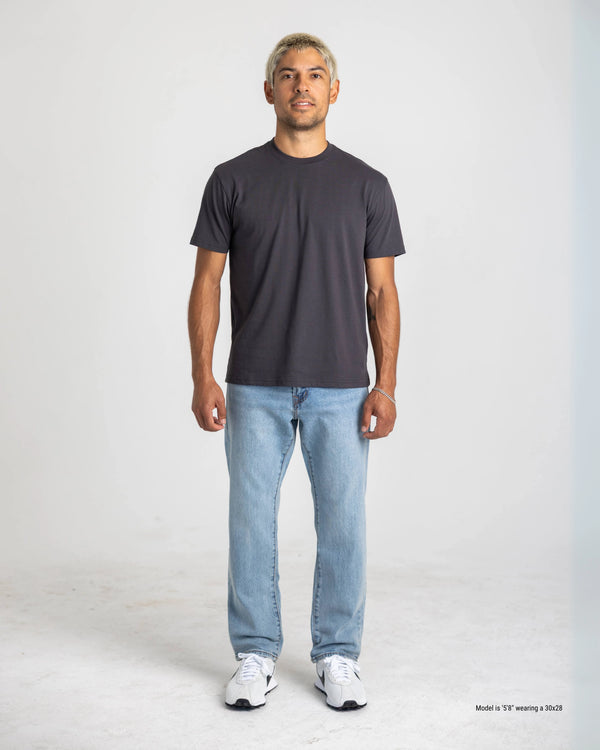
Jeans are where the proportion problem shows up most clearly. The inseam is the obvious issue — most brands offer 30" as their shortest, and a lot of shorter guys need 26–28". But inseam is only part of it. The rise, the knee placement, the taper from thigh to hem — all of these are set by the pattern, and on a standard pattern, they're calibrated for taller legs.
What to look for:
Inseam options of 26–28". A mid-rise cut (not low, not ultra-high) that sits where it's supposed to on a shorter torso. A leg opening that's proportional to the leg length — a 30" inseam with a 8.5" hem opening looks fine; the same 8.5" opening on a 27" inseam looks wide.
Abbreviated's jeans come in inseams from 25–28" and are cut for shorter proportions throughout — not just shortened at the hem. The lineup covers slim, standard straight, and loose fits, so there's an option regardless of what silhouette you wear. For a full breakdown of what to look for, fit comparisons, and which wash works for what, see the complete jeans guide.
If you're specifically interested in whether baggy or relaxed fits can work on a shorter frame — they can, with the right proportions — the baggy jeans guide covers that in detail. And if you need help figuring out what inseam you actually need, the inseam guide is the right starting point.
Pants
Pants for shorter men have the same core problem as jeans — rise that's too high, legs that are too long, and proportions that don't account for a shorter frame — but a few additional wrinkles. Dress pants and chinos often have excess fabric in the seat and thigh because the pattern assumes a different body length-to-leg ratio. The result is a silhouette that looks ill-fitted even after hemming.
What to look for: a clean seat with minimal excess fabric, a mid-rise cut, and a leg that tapers at a rate that makes sense for the inseam length. A 28" inseam pant should have a slimmer taper than the same pant in a 32" inseam — otherwise the proportions look off.
Abbreviated's chinos are built on a shorter pattern and come in inseams that work for shorter guys without hemming. For a more detailed breakdown of what goes wrong with standard pants and what to look for when buying, the pants guide covers it thoroughly.
T-shirts

T-shirts are easy to overlook as a fit problem — they're just t-shirts — but the torso length issue is real and consistent. Standard t-shirts are cut for longer torsos, which means they hang below the hip on shorter guys and break the visual line of the body. A shirt that fits in the chest and shoulders will often look sloppy at the hem.
The solution isn't buying a smaller size. Going down a size usually creates the opposite problem: the shirt might be shorter, but now it's too narrow in the chest and the armholes are too high and tight. The fix is a shirt that's cut shorter in the torso without changing the chest and shoulder dimensions.
There's also a sleeve length consideration. Standard short sleeves on a shorter arm often end in the wrong place — too far down the arm to look proportional. A slightly shorter sleeve hits a better spot on shorter arms.
Abbreviated's t-shirts are cut shorter in the torso and with proportional sleeve lengths — they're designed to fit at the natural waist rather than hanging over the hip. For a full breakdown of what to look for in t-shirt fit, fabric, and construction, see the t-shirt guide. And if you want to go deeper on how a t-shirt is supposed to fit specifically, the t-shirt fit guide covers shoulder placement, sleeve length, hem length, and chest fit in detail.
Jackets and outerwear

Outerwear is where the fit problem gets most visually obvious. A jacket that's too long doesn't just look off — it can actually make you look shorter by cutting the body at the wrong point and shortening the visual line of the leg. The classic issue is a jacket that should end at the hip but ends mid-thigh instead.
Sleeve length is the other common problem. Standard jacket sleeves are cut for longer arms, which means the cuff ends up at the palm rather than the wrist. This is fixable at a tailor, but expensive — sleeve alterations on a jacket run $30–60 per piece.
What to look for in outerwear: a hem that ends at or just below the hip, sleeves that end at the wrist bone, and shoulder seams that sit at the edge of your shoulder rather than drooping toward your arm. The shoulder seam position is especially important — it's one of the few things a tailor genuinely cannot fix without rebuilding the jacket.
The jacket guide covers the full outerwear category — what to look for, which jacket styles work best for shorter frames, and how to evaluate fit before you buy.
Fleece and sweatshirts

The same torso length issue that affects t-shirts shows up in fleece and sweatshirts, often worse — because fleece is typically cut even more generously to allow for layering. A standard hoodie or crewneck sweatshirt on a shorter guy often hits below the hip and can look more like a dress than a sweatshirt.
For shorter guys, the right fleece fits like a well-fitting t-shirt: at or just above the hip, with sleeves that end at the wrist. It should be long enough to tuck or layer over a shirt without riding up, but not so long that it changes the visual proportion of the lower body.
Abbreviated's fleece is proportioned the same way as the t-shirts — shorter torso, proportional sleeves, designed to sit at the natural waist. The fleece and sweatpants guide covers the full category, including how to think about sweatpants proportions for shorter guys.
What about athletic builds?
Shorter guys with athletic builds — broader shoulders, more developed chest and thighs relative to height — have an additional layer of fit complexity. Standard slim fits that work for a leaner frame are too tight in the chest and thighs. Relaxed fits that accommodate the extra muscle look baggy everywhere else.
The solution isn't just sizing up. A size larger might fit through the chest but adds excess fabric in the waist and makes the garment longer — which compounds the proportion problem. What actually helps is a fit with enough room in the right places (chest, seat, thigh) without adding overall volume. The guide to athletic builds covers this specifically, including which fits in the Abbreviated lineup work best for this body type.
How to dress taller (without trying too hard)
There are a few simple principles that create height optically. None of them require abandoning how you dress — they're mostly about applying what you already know about what looks good.
Monochromatic outfits work. Wearing one color family — navy top and navy pants, grey sweatshirt and dark jeans, black everything — creates an unbroken vertical line that reads as height. Breaking the line with a contrasting belt or a tucked shirt in a different color has the opposite effect.
Clothes that fit do more work than you'd expect. A shirt that hits at the right hem length doesn't just look better — it makes the legs look longer because you can actually see where the torso ends and the leg begins. Oversized or too-long clothes compress that visual line.
Avoid heavy horizontal elements in the upper body. Wide lapels, wide horizontal stripes, oversized graphics across the chest — these add visual width and reduce perceived height. Vertical details (a placket, a thin stripe, a simple pocket) do the opposite.
For a full breakdown of what works and what doesn't, including styling suggestions by category, see the how to dress taller guide.
Building a wardrobe from scratch
If you're starting over or just filling gaps, the most efficient approach is building a neutral core first and adding from there.
The basics that cover most situations: two or three t-shirts in neutral colors (white, black, grey, navy), one pair of jeans that fits well, one pair of pants (chinos work in most contexts), a midlayer (fleece or hoodie), and a jacket that works in your climate. That's a functional wardrobe. Everything else is an extension of it.
For shorter guys specifically, the order of operations matters. Get the jeans right first — they're the hardest to fit and the most visible when wrong. Then the t-shirts and tops. Outerwear can come last because it goes over everything and the stakes of one wrong jacket are lower than multiple ill-fitting basics.
The wardrobe guide goes deeper on this — how to sequence purchases, what a minimal functional wardrobe looks like, and how to build out from there without overcomplicating it.
The tailoring question
The conventional workaround for shorter guys is alterations. Hem the jeans, shorten the sleeves, take in the waist. And tailoring does help — a good hem job is cheap and makes a real difference.
But tailoring has limits. It fixes length. It doesn't fix proportions. A tailor can shorten your jeans from a 32" inseam to a 28" inseam — but the knee placement, the pocket position, and the taper rate were all built for 32" legs. After hemming, the jeans fit in length but still look off in ways that are harder to name.
There's also the cost. Hemming jeans runs $15–25 per pair. Shortening jacket sleeves is $30–60. If you're buying multiple pieces a year, you're spending real money to correct problems that shouldn't exist in the first place — and you're still not getting clothes that were built for your proportions.
The alternative is buying from brands that design for shorter proportions from the start. That means clothes where the inseam, torso length, sleeve length, and overall proportions were calibrated for a shorter frame — not adjusted after the fact.
Where to start
If you're new to Abbreviated, the best starting points depend on what's causing you the most friction right now.
- If it's jeans — inseam too long, rise too high, proportions wrong — start with the jeans guide and then browse the denim collection.
- If it's t-shirts — hem hitting too low, sleeves too long, chest right but torso wrong — start with the t-shirt guide and then the tops collection.
- If it's pants — excess fabric, wrong rise, wrong taper — start with the pants guide and the pants collection.
- If you're not sure what your inseam even is, or whether you need a 26" or 28", the inseam guide walks through how to measure and what to expect.
And if you want to understand the full wardrobe picture — not just individual pieces but how they work together — the wardrobe guide is the right place.
Everything in the Abbreviated lineup is designed for shorter proportions. No adjustments required.